
Folding-bike specifications: what the numbers leave out
Sources checked: 23 September 2026
A folding-bike specification sheet looks reassuringly tidy. Three measurements, a weight, a gear count. The awkward bit is working out what those numbers mean beside your front door, halfway up the stairs or on the slope that always seems to arrive just before home.
The most useful starting points are the space the folded bike needs, the weight of the version you would actually carry, and how low its lowest gear goes. Those answer different questions. Together, they can help you understand a bike you already own or make sense of a comparison with a clearer idea of what matters to you.
Folded size: the cupboard has an opinion
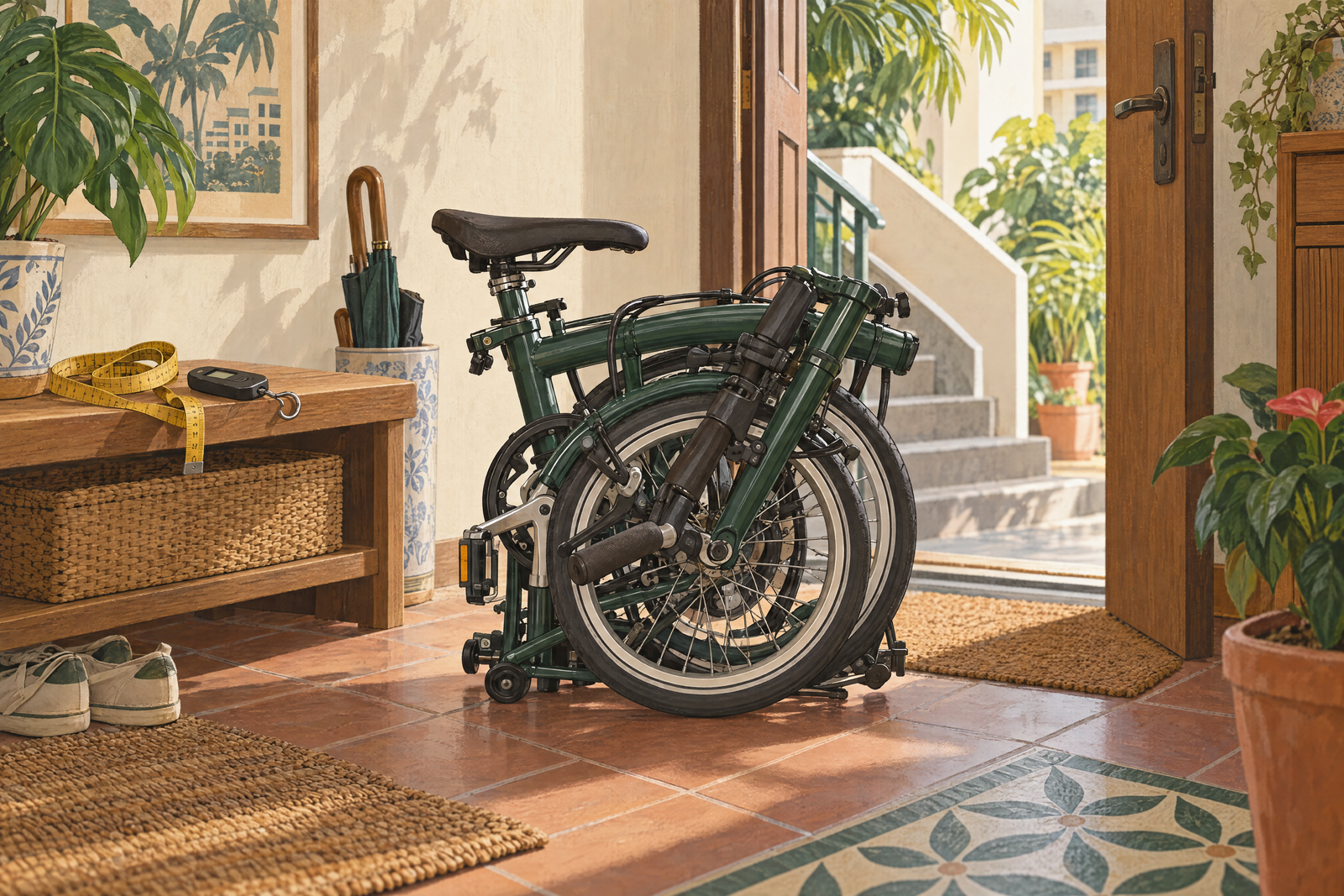
A folded-size figure is more useful when the measurements have names attached. Height, width and depth describe different edges; three unlabelled numbers leave a little too much room for interpretation. Brompton, for example, labels its folded measurements height × width × depth. That is a useful convention to retain when making notes, rather than assuming every listing follows it. Brompton’s specifications.
The configuration matters too. Tern’s specification notes say its published folded size may exclude racks and mudguards. A figure for one configuration may therefore need a second look when either is fitted. Tern’s specification notes.
For home storage, there are really two spaces to consider: the space inside and the opening the bike passes through. A tape measure across the cupboard door can be more revealing than its capacity in litres. Then there is room to get a hand around the bike and lift it out. The cupboard may accommodate it perfectly while remaining deeply unhelpful about letting it go.
If the fold is part of a train or bus journey, the relevant transport limit is another comparison altogether. Our Singapore public-transport guide covers those rules and the practicalities of making the transfer.
Weight: which bike is on the scales?
An advertised weight needs a little context: the model, equipment and configuration it describes. Brompton lists starting weights using “from”; that figure is a starting point for the range, rather than a promise about every version. Brompton’s specifications.
Tern is explicit that its published weights may exclude racks and mudguards, and that specifications can vary by country. That does not mean every brand leaves out the same equipment. It means a useful comparison includes a note about what was weighed. Tern’s specification notes.
Then comes the rest of an ordinary journey. A lock, water and a work bag still need to travel, even if none appears beside the bicycle’s headline weight. In his TWTopse bag review, Tom describes carrying a laptop, clothes, a towel and a drinks bottle: a recognisable reminder that a commute rarely consists of one unaccompanied bicycle.
A useful question is where the carrying happens. One doorstep, a flight of stairs and a station transfer make rather different demands on the same person. If there is a chance to try the folded bike, the interesting detail is how it sits in your hand while you manage the other things you normally bring. The weight figure cannot answer that part for you.
Gears: count, range and the bottom end
Gear count tells you how many selectable gears there are. It does not tell you where they begin and end. Shimano provides a neat component example: its 12-sprocket 11–34 cassette and 12-sprocket 11–36 cassette cover different tooth-count ranges. The same count can cover a different spread. These are examples of the numbers, rather than suggestions for fitting parts to a folding bike.
Gear range compares the highest gear with the lowest. A 300% range means the highest is three times the lowest. It tells you the spread, but leaves open where that spread starts. Rohloff explains the same relationship in its technical tables. Rohloff’s gearing reference.
Rollout, also called metres of development, is the distance travelled for one complete turn of the pedals in a particular gear. It brings wheel size and gearing together in one figure. Here is a deliberately hypothetical example, with no actual bicycle behind either row:
| Example | Lowest rollout | Highest rollout | Range |
|---|---|---|---|
| A | 2 metres | 6 metres | 300% |
| B | 3 metres | 9 metres | 300% |
Both ranges are 300%: highest ÷ lowest × 100. Yet A starts lower. In practical terms, other things being equal, a lower rollout means less force at the pedals, but more pedal turns over the same distance. Rohloff’s rollout explanation and gear-selection guidance.
For a complete bike, the lowest and highest rollout are useful figures to ask for. Comparing them with a familiar bike gives the numbers some everyday meaning. No single figure promises a comfortable hill for everyone; the rider, luggage and hill still get a say.
One small wheel-size wrinkle
Even an apparently familiar wheel label can be less precise than it sounds. Schwalbe’s size table includes both 305 mm and 349 mm diameters under “16-inch” names. Its ETRTO markings give tyre width and inner diameter in millimetres, making the intended size clearer. The inch label alone is not enough to establish tyre fit. Schwalbe’s size table and marking explanation.
Put the figures beside your usual week
Here is how those figures connect with an ordinary week:
| Your everyday question | The detail that helps |
|---|---|
| Where will it live? | Labelled folded dimensions, the equipment included and your storage opening. |
| Where will you carry it? | Weight in the relevant configuration, your usual load and the longest carrying stretch. |
| Which part of the ride asks the most? | Lowest rollout, compared with a bicycle or route you already know. |
There is room for preference after all that measuring. Perhaps the easy fold matters most on workdays, while the way a bike feels on a leisurely Sunday keeps you reaching for it. The figures help explain part of that choice. A ride, a fold and a lift add the bits that never quite fit in the table.