
Sharing Singapore’s park connectors: passing, pausing and busy stretches
Sources checked: 4 October 2026
A park-connector ride can change character in a few metres: open path, a playground entrance, two people chatting, then a lovely stretch beside the water. The useful approach is to read the path ahead, leave room for others and let the pace change with the surroundings. A slower minute needn’t spoil the outing. It may be the bit where you finally notice the view.
For a folding-bike rider, the small wheels and easy fold make a leisurely journey wonderfully convenient. They don’t change which paths allow cycling, or who needs space at the next corner. The distinction worth remembering is where riding is permitted, what the posted limit allows, and what feels appropriate around the people actually there.
The markings tell you which path you’re on
Singapore’s park connectors include shared and separated paths. A parallel strip of pavement is therefore not automatically another cycling lane. NParks’ path guide explains the different layouts, including sections where pedestrian and cycling routes meet again at entrances, playgrounds and other busy points.
For an ordinary pedal bicycle, LTA’s March 2026 path guide gives these general limits:
| Path | What it means for your ride |
|---|---|
| Footpath where cycling is permitted | Maximum 10 km/h. |
| Shared or cycling path | Maximum 25 km/h, unless a lower local limit applies. |
| Pedestrian-only path | Cycling is not permitted; use the adjacent cycling route. |
LTA began enforcement on converted pedestrian-only paths beside dedicated cycling paths on 1 July 2025. Its current rules page distinguishes those converted paths from standalone footpaths and shared paths. Ground symbols and signs are more useful here than guessing from the colour of the surface.
The general 25 km/h figure isn’t a target for every green route. NParks specifies 10 km/h on the Rail Corridor, for example. Its visitor guidance also asks cyclists to dismount and push across bridges. Our Rail Corridor planning guide covers the route’s access checks before an outing.
A bell starts a conversation, not a clearance
The nicest pass is usually the least memorable one. There is space ahead, the person knows you’re there, and neither of you has to make a sudden move.
LTA’s riding guidelines recommend a gentle alert before overtaking, keeping left otherwise and leaving a safe distance. A light bell ring can help announce your presence; it doesn’t establish that the person heard it or knows which way you intend to go.
If someone hasn’t responded, easing back gives the situation time to become clearer. When the opposite side is occupied, waiting behind is often simpler than trying to choreograph three people at once. Waiting a moment can save everyone an awkward sideways shuffle.
At a blind bend or crossing, the useful information is still hidden. NParks’ route-safety guidance advises against overtaking near crossings, corners and bends. Letting the view open up first makes the next decision much easier.
Busy sections have a different rhythm
NParks calls the red-dotted areas around features such as playgrounds, toilets, crossings and plazas Attention Zones. These can bring separated paths back into one shared space. Its guidance is to slow down and give way to pedestrians there.
That explains why a clear cycling stretch can suddenly feel less orderly near a park entrance. Someone may be joining the path rather than travelling along it. A child heading towards the playground has a different destination from yours, and probably a more urgent appointment with the slide.
LTA recommends walking the bicycle in crowded areas. A short walk through a cluster of people is still part of the ride; once the path opens again, you can settle back into pedalling. With friends, NParks recommends single file, which leaves more room for everyone passing in the other direction.
Leave a little room for the pause
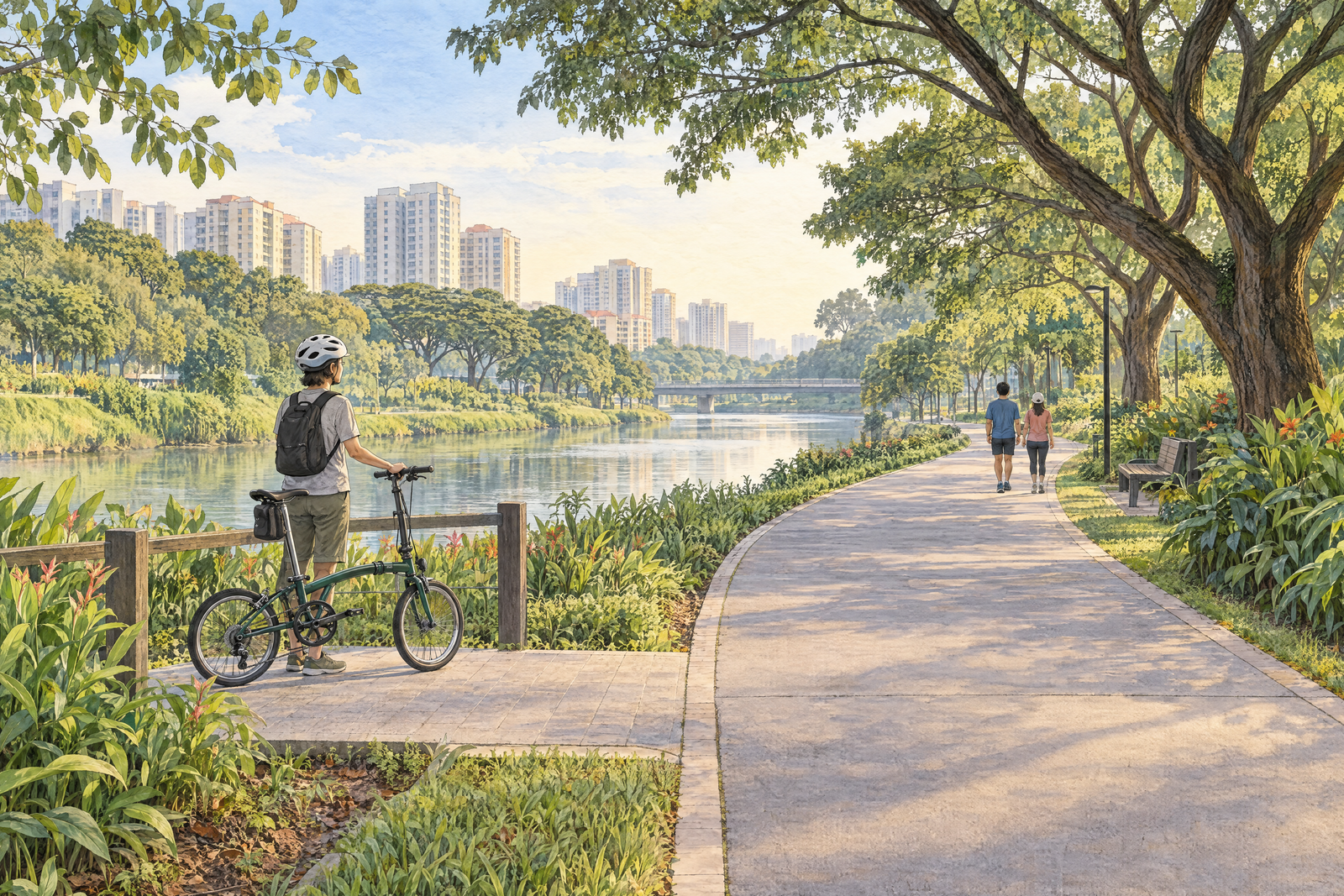
A drink, a photograph or a quick map check can be the whole reason for taking the scenic route. The easiest stopping place is a suitable paved recess or rest area clear of the travelling line, rather than the exit from a bend. There is less to keep negotiating when the bike, bag and rider are all comfortably out of the flow.
A folding bike offers another small convenience: if a café or rest area has limited room, folding can reduce the space it takes up, provided the venue permits it. It doesn’t need to become a performance every time you reach for your water bottle.
Here are four everyday moments and a relaxed way through them. These are editorial suggestions, rather than additional official rules:
| What you meet | A useful option |
|---|---|
| Two walkers ahead, with someone approaching | Leave the pass until the approaching person has gone and there is comfortable room. |
| A bend hiding the next stretch | Stay behind until you can see the path ahead. |
| A busy entrance or playground | Ease into the slower flow; walk the bike if riding would mean threading through people. |
| A view worth stopping for | Choose a clear rest space and enjoy it without blocking the path. |
The Singapore cycling weather guide helps with choosing a comfortable outing window; the MRT and bus guide covers the rules if the return journey includes a fold and a train.
A shared path has room for different sorts of outing: a commute, a family stroll, a gentle spin with nowhere urgent to be. Reading the next stretch gives those journeys space to fit together. You still get the greenery, the breeze and the pleasure of moving through the city on a very small bicycle.